Get the right experience for you. Please select your location and investor type.
IMPORTANT NEWS: Transition of investment management responsibilities
First Sentier Group, the global asset management organisation, has announced a strategic transition of Stewart Investors' investment management responsibilities to its affiliate investment team, FSSA Investment Managers, effective Friday, 14 November close of business EST.


Global Emerging Markets Leaders
The Global Emerging Markets Leaders strategy launched in April 2020. It invests in 25-60 high-quality emerging market companies that we consider to be particularly well positioned to contribute to, and benefit from, sustainable development.
Leaders simply means that the strategy is focused on companies with a market cap value of at least USD1 billion.
Strategy highlights: a focus on quality and sustainability
- We invest in high-quality companies with exceptional cultures, strong franchises and resilient financials. How we pick companies >
- Our approach is long-term, bottom-up, high conviction and benchmark agnostic
- We focus on capital preservation as well as capital growth – we define risk as the permanent loss of client capital
- Companies must contribute to sustainable development. Portfolio Explorer >
- We avoid companies linked to harmful activities and engage and vote for positive change. Our position on harmful products >
Strategy name change
Please note, from 21 November 2024 Stewart Investors Global Emerging Markets Leaders Sustainability name will be updated to Global Emerging Markets Leaders. By 30 September 2025, the Stewart Investors NZ PIE Fund name will be updated to reflect these Strategy name changes. Please refer to this note for further information.
Latest insights


Quarterly updates
Strategy update: Q4 2025
Global Emerging Markets Leaders strategy update: 1 October - 31 December 2025
In November 2025, First Sentier Group (FSG) announced a strategic transition of Stewart Investors’ (SI) investment management responsibilities to its affiliate investment team, FSSA Investment Managers (FSSA). This was decided to be in the best interests of our clients, given the significant overlap in SI’s and FSSA’s investment capabilities and our shared history and heritage.
Introducing FSSA Investment Managers
FSSA has been investing in Asia Pacific and Global Emerging Market equities since 1988 as part of the former Stewart Ivory & Company, which subsequently became First State Stewart. After years of organic growth, the First State Stewart team split in two in 2015, leading to the formation of FSSA Investment Managers and Stewart Investors.
Like SI, we are long-term and quality-focused investors. We pay little attention to the index or short-term performance, preferring to focus on generating absolute returns for our clients in the long run. From our research, we aim to construct relatively concentrated portfolios made up of the best ideas that we can find across Asia and emerging markets. As responsible, long-term shareholders, we have integrated sustainability analysis into our investment process and engage extensively with companies on environmental, labour and governance issues.
Following the transition of SI’s portfolios to FSSA, the Stewart Investors Global Emerging Markets Leaders portfolio is now being managed by Rasmus Nemmoe and Rizi Mohanty.
Rasmus Nemmoe is a Portfolio Manager at FSSA Investment Managers. He joined the team in 2016 and is the lead manager of the FSSA Global Emerging Markets Focus strategies. Rasmus has more than 20 years of investment experience and is based in Hong Kong.

Rizi Mohanty is a Portfolio Manager at FSSA Investment Managers. He joined the team in 2016 and focuses on the Southeast Asian markets as well as Asia ex-Japan equities more broadly. He is the lead manager of the FSSA ASEAN All Cap and FSSA Asian Growth strategies. Rizi has more than 14 years of investment experience and is also based in Hong Kong.
Rasmus and Rizi are supported by a broader team of investment analysts, with an average of 16 years of investment experience and 8 years tenure with the team. All 15 members of the FSSA investment team are analysts first and foremost, including the portfolio managers, and we spend the majority of our time meeting companies, writing research and seeking quality companies to invest in.
How we invest
FSSA’s investment philosophy, which shares its genesis with SI, has remained broadly unchanged since the First State Stewart team was established in 1988. We focus on identifying quality companies, buying them at a sensible price and holding them for the long term. Most importantly, we invest our clients’ capital as if it were our own. As long-term investors and owners of businesses on behalf of our clients, we look for founders and management teams that act with integrity and risk awareness, and dominant franchises that have the ability to deliver sustainable and predictable returns over the long term.
As a team, we conduct over 1,000 direct company meetings each year across Asia and other emerging markets. The most significant source of investment ideas comes from these company visits and country research trips. We find that our reputation as patient, long-term investors has given us unparalleled access to management, which allows us to gain valuable insights and a thorough understanding of the businesses we want to invest in.
As a result of our long-term time horizon and conservative investment approach, our portfolios – and our performance – can look very different to the index. We shy away from “flavour of the month” themes (such as the current AI-driven boom), and instead look for high-quality companies that can deliver attractive returns for much longer than the market expects – and extend our investment time horizon to capture that advantage. When you own quality businesses, time isn’t a risk – it’s an asset.
Our performance may lag in very buoyant or momentum-driven markets, but we usually compensate very quickly once such bubbles burst. Based on historical data, our long-term track record shows that our portfolios tend to perform better in “normal” markets (-15% to +15% returns over one year) and bear markets (more than 15% decline), than in steeply rising markets (defined as over 15% returns over one year).
A smooth transition
Given the significant overlap in SI’s and FSSA’s investment philosophy and portfolios, we know all the holdings well. As part of the transition, we made a few changes to tilt the portfolio towards companies with stronger cash generation, higher returns and better long-term growth prospects. In general, we are adding to holdings in China, where we have found leading businesses like Tencent, with strong competitive advantages and attractive growth at reasonable valuations. We are reducing exposure to India, mainly in cyclical businesses like Tube Investments of India and Motilal Oswal, where valuations are expensive and the growth outlook has deteriorated.
Below, we highlight a few of the key additions and disposals over the fourth quarter of 2025.
New purchases:
Prosus is one of the largest technology investors in the world. While listed in South Africa and Holland, a significant majority of Prosus’ assets are located in emerging markets. In addition to its 25% ownership stake in Tencent, which has been its most successful investment to date, Prosus has stakes in leading food delivery, classifieds and payment platforms in places such as Brazil, Eastern Europe and India. The company also has a notable track record of exits including FlipKart (India), Allegro (Poland) and MakeMyTrip (India) to name a few. The company remains attractively valued with a significant discount to its underlying assets. Management also have an ongoing buyback program funded by the gradual sale of its Tencent stake, which should boost NAV per share.
Mediatek is one of the largest chip design companies globally. We have been following Mediatek for many years and have witnessed its performance through the cycles. Throughout the ups and downs in its history, its talented engineers and well-aligned management team usually find a way through to the next “big thing”. From optical drives for computers to scan CDs, it entered the smartphone supply chain with 2G modem chips and benefited from technology upgrades each year – until it collapsed in 2015-17 amid poor execution and competition from both low- and high-end competitors. In 2018 Rick Tsai joined Mediatek from TSMC and focused on getting the basics right again. We believe Mediatek has been transformed under his leadership into a better-quality company. In recent years, the company has improved its competitiveness, and we believe its market share will likely remain stable. With the smartphone market now in the mature stages, the company is investing into new areas (ASIC, auto, augmented reality/virtual reality, Internet of Things, artificial intelligence) to diversify and internationalise its business in the long run.
Credicorp is a financial group in Peru with a leading position in loans, deposits, microfinance, insurance and wealth management. It holds nearly 40% share of the current and saving account (CASA) market and remains family-owned by the Romeros who have a 12% stake. The group has successfully incubated a fintech offering called Yape to avoid being disrupted by outsiders. Meanwhile, Peru’s financial penetration remains low even within Latin America, at just 48% credit to gross domestic product (GDP). With a leading deposit franchise, prudent culture and scale advantages, we are confident in Credicorp’s ability to grow while generating attractive returns in the long term.
Complete sales:
Godrej Consumer Products is a quality family-owned consumer company with a long track record in India. It has undergone a turnaround under a new (professional) CEO, but the valuation looks expensive for the expected growth.
Motilal Oswal Financial Services is a non-bank financial company (NBFC) in India. We sold out of a lower conviction holding to raise cash for better ideas elsewhere.
Voltronic Power is a Taiwanese company specialising in uninterruptable power supply (UPS). We sold out of a lower conviction holding to raise cash for better ideas elsewhere.
Performance and outlook
With our long-term investment time horizon, we tend not to pay much attention to short-term market fluctuations. We invest on at least a three-to-five-year view, though we often hold on to companies for much longer. In an industry rife with short-termism, we believe our long-term approach stands out from the crowd.
What we have seen, over the past few decades, is that average holding periods for stocks have fallen from over eight years in the 1960s to less than six months today. Yet this shift has come at a cost: it reduces investors’ ability to generate outsized returns that are materially different from the broader market. The reason is simple — as investment horizons shrink, so does the return dispersion between the best- and worst-performing companies. With less time in the market, investors end up tracking the index, not beating it.
Emerging Markets: time horizons matter
MSCI EM Index -dispersion around mean return for top 10% top / bottom stock performers
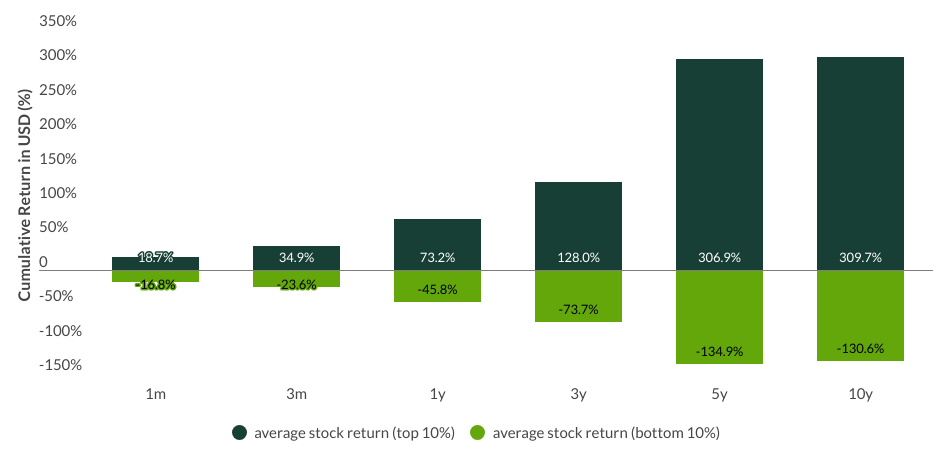
Source: MSCI Emerging Markets Index, as at 31 May 2025
In a world where markets rise consistently, that might seem like an acceptable outcome. But markets don’t move in straight lines; and in addition to the higher costs and transaction fees that come with frantic trading activity, the bigger issue is that investors miss out on what is far more important – the future value creation that the best companies tend to generate. This is often poorly understood by the market, with many investors simply focusing on the next quarter or year ahead. Yet the real drivers of returns lie in the cash flows that come well beyond that timeframe.
With that context in mind, we highlight the key contributors and detractors from performance over the fourth quarter of 2025.
The largest contributor to performance over the period was Samsung Electronics, a leading manufacturer of memory and semiconductor chips. In recent years, Samsung’s foundry business has been a major point of investor concern, which culminated in significant losses in the first half of 2025. These losses were exacerbated by one-time charges related to US export controls to China. The company has since undertaken a strategic shift from a “capacity-first” to a “customer-first” model, which appears to be bearing fruit. The shares rose during the quarter, as Samsung continued to benefit from surging AI-related demand for its high-bandwidth memory chips as well as tightness in traditional DRAM demand-supply. Strong results from US chipmaker Micron reinforced expectations of a sustained memory upcycle into 2026. With the turnaround in its foundry business and a strong legacy memory business, we believe the risk-reward looks favourable.
Taiwan Semiconductor Manufacturing (TSMC) was the second largest contributor to performance, as it continued to see solid revenue growth and strong demand from cloud AI for its leading-edge chips. Given the lead time and supply shortages, this provides visibility into 2026 earnings and possibly even beyond into 2027. TSMC is expected to invest in capacity expansion, with top line growth to follow.
The third largest contributor to performance was WEG, a Brazilian multinational electrical-equipment company. A leader in transformers and industrial electric motors, WEG continued to deliver solid profits in 2025, despite facing challenges due to US tariffs on imports from Brazil. Over the longer term, AI-driven power demand and the ongoing electrification of grids in Brazil and other key markets where WEG has a presence – including Mexico and South Africa – is expected to drive stronger revenue growth in the company’s core transformer business.
On the negative side, Tube Investments of India was the biggest detractor from performance, as it reported sluggish business performance and rising competition in the electric vehicle (EV) space. Despite its early mover advantage, Tube has struggled to maintain market share. It plans to arrest these challenges by increasing the number of dealership partners and entering new sub-segments in EV battery packs. On a positive note, the core business is stable with robust returns on capital employed, and it generates healthy free cash flow which is being invested in new businesses with high returns potential. In this endeavour, we are backing the management, particularly Vellayan Subbiah (executive chairman), who has an exceptional track record and has created tremendous value for shareholders.
Alibaba was the second biggest detractor. The shares weakened over the last few months of 2025 on concerns about its e-commerce business and the resulting pressure on earnings. Losses from its Taobao Instant Commerce business (food delivery and on-demand retail) weighed on the share price. On the other hand, Alibaba has had a strong run-up over 2025, driven by its investments into AI and growing demand for cloud computing. Alicloud revenue has accelerated in recent quarters and is expected to continue at pace in the coming quarters.
Milkyway Intelligent Supply Chain, a leading Chinese chemical materials logistics firm, was the third biggest detractor, declining due to underwhelming earnings results. The company’s revenue and profit growth lagged analyst expectations due to weak demand across China’s chemicals sector. While this weakness is likely to persist into 2026, the company is taking steps to improve the efficiency of its operations. Milkyway recently announced the launch of its new Fangchenggang hazardous chemicals base, which integrates warehousing with maritime, rail and road transport, and will allow Milkyway to offer customers improved supply chain services in southern China.
Looking forward
Despite the geopolitical uncertainty triggered by the US administration’s reciprocal tariff policy, emerging-market equities delivered robust performance in 2025. This reflects longer-term developments. The global economy is increasingly being led by emerging markets, a trend we expect to accelerate in the future. As concerns grow over the health of the US economy, investors are considering alternatives, as indicated by the strong demand for emerging-market equities over the last year.
Amid the market rise, it is important to keep a close eye on valuations. The growth in AI-related spending has led to a particularly sharp increase in the shares of chipmakers and other technology firms. While some of the Fund’s key holdings are benefiting from this trend, it is important not to get carried away by the hype around generative AI. In the tech sector as elsewhere, the Fund focuses on businesses with proven management teams and competitive advantages that allow them to capitalise on long-term shifts across emerging markets.
Whether it is the development of Chinese cities as hubs for innovation in medical devices, the formalisation of the Indian economy, the continued financialisation of the South African population, or the growing enterprise resource planning (ERP) adoption by Brazilian SMEs, there are plenty of investment opportunities in emerging markets. Yet these kinds of businesses are not widely included in major market benchmarks, which is why the Fund focuses on high-quality companies rather than following the crowd.
SFDR Article 9 and FSSA’s approach to sustainability
All SI portfolios will continue to be managed true to label, with due consideration given to SI’s SFDR Article 9 sustainability requirements. Importantly, both FSSA and SI had operated as one team for 27 years (1988-2015) before the decision was made in 2015 to split into two teams. This is heavily reflected in our investment philosophies and processes and our respective approaches to sustainability.
At FSSA, we believe it is everyone’s responsibility to think about sustainability as part of his or her investment decision-making. We don’t use external consultants or environmental, social and governance (ESG) ratings, nor do we outsource the sustainability work to a separate team. In our research, we focus on evaluating the long-term merits of a given investment opportunity. Given that sustainability issues are effectively investment issues, we believe that these challenges and opportunities – and management’s response to them – can have a significant impact on a company’s returns. As such, we look for evidence that the management operates the business effectively and in the interests of all stakeholders – both now and for the longer term.
While issues relating to climate change, or people and communities, are often the ones that get the most attention, most of our company engagements relate to management quality and corporate governance systems, as we believe that good governance is the foundation on which great companies are built. We often engage with management teams on capital allocation and strategy, remuneration structures and succession planning, board diversity and tenure, and ensuring high levels of transparency and company disclosure – to highlight just a few.
For more information on FSSA, or if you have any questions about the transition, please do not hesitate to contact us.
NB Both Stewart Investors and FSSA have been supported by the same centralised Responsible Investment team within the First Sentier Group, who will continue to support FSSA after the transition of SI funds.
Source for company information: Stewart Investors investment team and company data. This stock information does not constitute any offer or inducement to enter into any investment activity. Portfolio data shown is from representative strategy accounts of the strategy shown above. Named new investments disclosed relate to holdings with a portfolio weight over 0.5%. It is not a recommendation or solicitation to purchase or invest in any fund. Differences between the representative account-specific constraints, currency or fees and those of a similarly managed fund or mandate would affect results.
Download a PDF copy
Select Strategy update to produce a report. You can then download a copy of the report by clicking on the button.
You can build a bespoke report for all our strategies on the full Quarterly update report.

Strategy update: Q3 2025
Global Emerging Markets Leaders strategy update: 1 July - 30 September 2025
Emerging markets enjoyed another strong quarter. Given that market indices were driven higher by sharp gains for Chinese stocks that are seen as beneficiaries of the artificial intelligence (AI) boom, it is unsurprising that returns from our strategy lagged some way behind those from the benchmark.
Although some of our Chinese holdings, such as Alibaba and Tencent, performed well, not all of our holdings there are aligned with the AI theme. Such periods of thematically driven exuberance can be challenging for long-term investors in high-quality businesses who are disciplined around valuations. But we know that our philosophy and process have been proven to deliver over the long term. One of our team, Doug Ledingham, recently wrote a piece explaining why we consciously resist the growing pressure to focus on the short term:
“At Stewart Investors, we have always sought to occupy a space that protects our clients’ capital. One of the threats we are striving to protect it from is short-termism: from the incessant distraction provided by 24-hour news, from the temptation to digest every morsel of noise, from the danger of trying to react to every macro data point or tweet, and from the pressure to fixate on quarterly earnings. That’s increasingly important in a world where long-term thinking is in increasingly short supply.”
You can read the rest of the piece here: Slow has all the power: why we invest alongside long-term owners. It helps to explain why we won’t be abandoning our core beliefs as long-term fundamental investors to chase the AI-driven rally in a bid to match returns from the index in the short term.
The long-term outlook for Indian companies remains bright
The quarter saw a continuation of an unhelpful dynamic: the significant outperformance of the Chinese market relative to India, to which this strategy has a significantly higher level of exposure. Despite this, we remain enthusiastic investors in high-quality companies aligned with India’s economic development. So far, this year has seen a reduction in income taxes and a simplification of the Goods and Service Tax (‘GST’) system. The Reserve Bank of India, meanwhile, has been cutting interest rates. So demand is now being supported by both fiscal and monetary loosening.
There is, of course, more to emerging markets than China and India. Recent trip reports from Indonesia, India and the Philippines are available on our Insights page. Having visited South Korea in September, we are increasingly confident in the changes to corporate governance standards that are unfolding in that country. These echo similar reforms seen in Japan and should have positive effects on shareholder returns in Korea and perhaps across the region more widely – a similar mood of reform now seems to be infecting other countries across Asia.
Continuity and change
It would be remiss not to mention the changes that have taken place at Stewart Investors over the last quarter. After acting as careful stewards of our clients’ capital over many years, three of our colleagues stepped back from their portfolio-management responsibilities in August and left the business. While the list of portfolio-management responsibilities within our team looks different now than it did when the quarter began, on a deeper level, nothing has changed: the philosophy and approach that has defined Stewart Investors since 1988 is deeply engrained and continues to define what we do. Our structure is flat. Every member of the investment team is first and foremost an analyst and our collective focus is on identifying high-quality companies, with resilient financials, guided by ambitious stewards.
Jack Nelson remains this strategy’s lead manager. He continues to apply the same principles to managing it that have guided it since its launch, working as part of the same tight-knit group of investment analysts and drawing on a common pool of investment ideas.
Activity
We added three new holdings to the portfolio over the quarter. There were no complete sales.
In addition to Shopee, the dominant e-commerce platform in Southeast Asia, Sea (Singapore: Consumer Discretionary) owns digital entertainment brand Garena and provides digital financial services through SeaMoney. Shopee is increasingly well established around the world, employing 45,000 ‘partner-drivers’ in Brazil.1 We believe Sea now has an opportunity to expand into new markets as well as increasing the penetration of Shopee and SeaMoney. The company’s founder, Forrest Li, remains closely involved in the business but is now supported by a professional management team. He has built a great franchise backed by solid financials (the company has net cash on its balance sheet) that empowers millions of small businesses to grow and create jobs by giving them direct access to their customers.
We also added a new holding in Motilal Oswal Financial Services (India: Financials), a brokerage and wealth management business that is poised to benefit from the desire of India’s increasingly wealthy middle class to have greater access to capital markets. It is still managed by its founders, including the eponymous Motilal Oswal and we can see a steady growth path ahead for the coming decades.
The final new position is MakeMyTrip (India: Consumer Discretionary), a leading online travel website. It should benefit from a continuing shift in India towards booking travel online. Meanwhile, as the disposable incomes of Indian consumers grow, they will increasingly want to travel overseas as well as domestically. While it is 49% owned by Trip.com, the Chinese online travel business, the company’s founders remain involved in the business’s day-to-day activities, supported by a professional management team. It is already a leader in the online travel space in India but the real growth opportunity lies in the offline segment, specifically in bus and hotel bookings, many of which continue to be made in bricks-and-mortar travel agencies.
[1] Source: Sea Shopee Celebrates 5 Years in Brazil, Strengthening Income Generation and Entrepreneurial Growth.
Source for company information: Stewart Investors investment team and company data. This stock information does not constitute any offer or inducement to enter into any investment activity. Portfolio data shown is from representative strategy accounts of the strategy shown above. Named new investments disclosed relate to holdings with a portfolio weight over 0.5%. It is not a recommendation or solicitation to purchase or invest in any fund. Differences between the representative account-specific constraints, currency or fees and those of a similarly managed fund or mandate would affect results.
Strategy update: Q2 2025
Global Emerging Markets Leaders strategy update: 1 April - 30 June 2025
The announcement of President Trump’s ‘Liberation Day’ tariffs on 2 April and the short, sharp trade war with China that followed ensured a volatile start to the quarter for emerging markets. The uncertainty drove share prices sharply lower until the announcement of a 90-day pause on the introduction of the tariffs helped to calm investors.
That calm endured even when Israel took direct military action against Iran, with the oil price spiking higher only briefly. Perhaps the most interesting development from our perspective, however, was that the US dollar had its weakest start to the year since 19731. We think the pressure on the dollar could persist and may, in time, encourage capital to flow into emerging markets.
We added four new holdings over the quarter: two in China and two in India. Trip.com (China: Consumer Discretionary) is the country’s largest online travel-booking platform. The company’s founders remain involved in the business and have seen it grow organically as well as through mergers and acquisitions. It survived the dead stop in tourism in the covid pandemic and now seems primed to take advantage of a shift to booking travel online. While only about 10% of the Chinese population currently has a passport that proportion is expected to increase2. We took advantage of the volatility at the start of the quarter to build a new position in Tencent (China: Communication Services). The reach of WeChat, a ‘super app’ that allows its users to do almost everything online, is unparalleled in China. Tencent is aligned with the state’s desire to work in partnership with private companies to reinvigorate the economy. It is also enabling China to shift computing tasks to the cloud, which is more energy-efficient than on-premises IT infrastructure.
Cholamandalam Financial Holdings (India: Financials) is an Indian financial services business rolling out general insurance across India. It is associated with the Muragappa family, who we believe to be good stewards of our clients’ capital. ICICI Lombard (India: Financials) is also an insurer. Prime Minister Modi is committed to a programme of delivering ‘insurance for all’ by 2047; we believe both companies will benefit from this drive.
We sold the holding in Jerónimo Martins, the Portuguese-listed owner of Poland’s Biedronka supermarket chain and of Ara in Colombia (around 80% of the group’s revenues are generated in Poland and Colombia)3. We like the company’s management and the outlook for the business, but the stock has performed well and we struggle to see enough growth coming through to warrant the shares’ current valuation.
Elsewhere, we have become increasingly concerned about the outlook for IT services businesses, particularly those with a significant level of exposure to the US. We see a risk that its clients postpone or cancel investments in their IT systems due to the uncertainties currently facing the US economy. As part of our ongoing review of this sector, we also trimmed the holding in Globant (Argentina: Information Technology). We understand the argument that some companies will need IT services businesses to help them to adopt and integrate artificial intelligence (AI) tools. Equally, it may be that its clients actually use AI to replace their existing IT services.
Looking ahead, renewed weakness in the dollar could be the trigger for capital currently domiciled in the US to begin to flow into emerging markets. We remain particularly positive on the prospects for high-quality companies in India. The central bank recently started cutting interest rates, which is a clear positive for demand in rural India. Towards the end of the quarter, we attended a conference of Indian companies and were struck by how positive all of them were about the growth opportunities before them over the next 10 years. In our view, this potential growth – and the size of the Indian market – continues to offer powerful support to valuations.
[1] Source: Financial Times, 30 June 2025 ‘US dollar suffers worst start to year since 1973’.
[2] Source: Straits Times, 21 December 2023 ‘China is world’s second-largest economy but its passport is ranked 63rd. Are things looking up?’.
[3] Source: Jeronimo Martins Operational and Financial Indicators q1 2025.
Source for company information: Stewart Investors investment team and company data. This stock information does not constitute any offer or inducement to enter into any investment activity. Portfolio data shown is from representative strategy accounts of the strategy shown above. Named new investments disclosed relate to holdings with a portfolio weight over 0.5%. It is not a recommendation or solicitation to purchase or invest in any fund. Differences between the representative account-specific constraints, currency or fees and those of a similarly managed fund or mandate would affect results.
Strategy update: Q1 2025
Global Emerging Markets Leaders strategy update: 1 January - 31 March 2025
The volatility seen across emerging markets in the final quarter of 2024 carried over into 2025. Share prices in India fell sharply due to concerns about a cyclical slowdown. China, by contrast, performed well as investors anticipated a reacceleration in economic growth and began to identify value in many parts of the market. Sentiment was also supported by President Xi, who met executives from a number of private-sector companies.
We added 10 new holdings to the portfolio over the quarter and sold seven. Although it is unusual to see so many names exiting and entering the portfolio, turnover as a percentage of assets under management remained low at around 12%1. We were, in essence, simply tidying up a number of our smaller positions – the ‘tail’ of the portfolio.
In China, we sold out of Glodon (China: Information Technology), Hangzhou Robam (China: Consumer Discretionary), WuXi Biologics (China: Health Care), Ping An Insurance (China: Financials) and Hong Kong Exchanges and Clearing (Hong Kong: Financials). The first two sales were informed by our view of China’s property market, where we don’t see the issue of oversupply being resolved any time soon. Glodon provides software for construction and development companies. The majority of Hangzhou Robam’s appliances, meanwhile, are sold to housing developers. WuXi Biologics was a small position and we couldn’t see any immediate prospect that the ongoing challenges posed by US government trade policy would be resolved. Although Ping An Insurance and Hong Kong Exchanges and Clearing had both performed well, we sold them to reallocate the capital into new investment ideas such as Alibaba (China: Consumer Discretionary), S.F. Holding (China: Industrials) and Mindray (China: Health Care).
Alibaba is one of China’s leading e-commerce platforms. It is using the strength of its balance sheet to invest in its AI capabilities. S.F. Holding has grown into one of China’s leading logistics businesses since its foundation in 1992. Its founder is still involved in the company’s day-to-day management. Mindray is a leading medical company. As trade barriers are thrown up around the world, it has the potential to benefit should there be a shift in China towards buying domestically sourced products.
Elsewhere, we added a handful of new names and trimmed some existing positions. We took some profits in Marico (India: Consumer Staples) and reallocated the capital to Info Edge (India: Communications), Tube Investments (India: Consumer Discretionary), Bajaj Auto (India: Consumer Discretionary) and Bajaj Holdings & Investment (India: Financials). These companies had been on our focus list for a while but their valuations had dissuaded us from establishing positions. InfoEdge is a technology company whose online jobs portal caters to 132,000 corporate customers and hosts around 100 million CVs2. It also has property, matchmaking and educational portals. Tube Investments is an industrial conglomerate whose share price had fallen sharply, providing us with what we believe is an excellent entry point. Bajaj Auto had also sold off allowing us to add this leading manufacturer of motorcycles, scooters and auto rickshaws, which is backed by a high-quality steward. Bajaj Holdings & Investment is the holding company of siblings Rajiv and Sanjiv Bajaj. They have demonstrated an exemplary track record of delivering returns for shareholders in autos and financial services.
Elsewhere, we sold convenience store business Dino Polska (Poland: Consumer Staples), which had performed well but which had become too expensive for its long-term growth expectations. We also sold Unicharm (Japan: Consumer Staples). While it has pivoted to adult diapers in response to demographic change, it has found this shift harder than it had originally envisaged.
We built positions in Samsung Biologics (South Korea: Health Care), Alfamart (Indonesia: Consumer Staples), Voltronic Power (Taiwan: Industrials) and BDO Unibank (Philippines: Financials). We believe Samsung Biologics can use the strength of its parent company’s balance sheet to add capacity more quickly than its competitors and win market share. Alfamart is the second biggest player in Indonesia’s convenience-store sector3. It plans to roll out new stores across the country over the next decade. Its shares sold off as the market took fright at Indonesia’s new government but we can see a clear and dependable growth path before it. Voltronic Power makes uninterruptible power supply units (PSUs). We expect demand for these to increase steadily as a new generation of data centres is built worldwide. Finally, BDO Unibank is the Philippines’ largest lender4. It is backed the Sy family, who we believe are great long- term stewards.
While we are broadly positive on the outlook for emerging markets, we recognise that there is likely to be ongoing volatility for as long as ‘top-down’ uncertainty – inspired by trade tariffs and geopolitical flux – remains at elevated levels. Valuations are certainly attractive and there remains plenty of domestically driven growth in the markets we favour. Our task is to block out the short-term noise to focus on the underlying quality, growth and stewardship of the companies we invest in.
[1] Source: FactSet as of 31 March 2025.
[2] Source: InfoEdge: Annual Report 2023-24.
[3] Source: Fitch Ratings Fitch Revises Alfamart's Outlook to Positive; Affirms at 'AA(idn)'.
[4] Source : BDO Unibank – Company Profile (as of 31 December 2024).
Source for company information: Stewart Investors investment team and company data. This stock information does not constitute any offer or inducement to enter into any investment activity. Portfolio data shown is from representative strategy accounts of the strategy shown above. Named new investments disclosed relate to holdings with a portfolio weight over 0.5%. It is not a recommendation or solicitation to purchase or invest in any fund. Differences between the representative account-specific constraints, currency or fees and those of a similarly managed fund or mandate would affect results.
Portfolio Explorer
If you are unable to view the portfolio explorer, please re-open in Google Chrome, Edge, Firefox, Safari or Opera. IE11 is not supported.
For illustrative purposes only. Reference to the names of example company names mentioned in this communication is merely for explaining the investment strategy and should not be construed as investment advice or investment recommendation of those companies. Companies mentioned herein may or may not form part of the holdings of Stewart Investors. Holdings are subject to change.
Certain statements, estimates, and projections in this document may be forward-looking statements. These forward-looking statements are based upon Stewart Investors’ current assumptions and beliefs, in light of currently available information, but involve known and unknown risks and uncertainties. Actual actions or results may differ materially from those discussed. Readers are cautioned not to place undue reliance on these forward-looking statements. There is no certainty that current conditions will last, and Stewart Investors undertakes no obligation to correct, revise or update information herein, whether as a result of new information, future events or otherwise.
Source: Stewart Investors investment team and company data. Securities mentioned are all investee companies* from representative Asia Pacific All Cap Strategy, Asia Pacific & Japan All Cap Strategy, Asia Pacific Leaders Strategy, Global Emerging Markets (ex China) Leaders Strategy, Global Emerging Markets Leaders Strategy, Global Emerging Markets All Cap Strategy, Indian Subcontinent All Cap Strategy, Worldwide All Cap Strategy and Worldwide Leaders Strategy accounts as at 30 September 2025. *Assets that the strategies may hold which an active decision has not been made, and sustainability assessment does not apply, include cash, cash equivalents, short-term holdings for the purpose of efficient portfolio management and holdings received as a result of mandatory corporate actions. Holdings of such assets will not appear on Portfolio Explorer. Not all strategies are available in all jurisdictions or to all audience types.
The Stewart Investors supports the Sustainable Development Goals (SDGs). The full list of SDGs can be found on the United Nations website.
Source for Climate Solutions and impact figures: © 2014–2025 Project Drawdown (drawdown.org). Source for Human Development Pillars: Stewart Investors investment team.
Source for climate solutions and human development analysis and mapping: Stewart Investors investment team. Contributions are defined by the team as demonstrable contributions to any solution, either direct (directly attributable to products, services or practices provided by that company), or enabling (supported or made possible by products or technologies provided by that company).
Investment terms
View our list of investment terms to help you understand the terminology within this website.

An affiliate of First Sentier Group
Copyright © 2026 Stewart Investors.