Get the right experience for you. Please select your location and investor type.
IMPORTANT NEWS: Transition of investment management responsibilities
First Sentier Group, the global asset management organisation, has announced a strategic transition of Stewart Investors' investment management responsibilities to its affiliate investment team, FSSA Investment Managers, effective Friday, 14 November close of business EST.


Global Emerging Markets Leaders
The Global Emerging Markets Leaders strategy launched in April 2020. It invests in 25-60 high-quality emerging market companies that we consider to be particularly well positioned to contribute to, and benefit from, sustainable development.
Leaders simply means that the strategy is focused on companies with a market cap value of at least USD1 billion.
Strategy highlights: a focus on quality and sustainability
- We invest in high-quality companies with exceptional cultures, strong franchises and resilient financials. How we pick companies >
- Our approach is long-term, bottom-up, high conviction and benchmark agnostic
- We focus on capital preservation as well as capital growth – we define risk as the permanent loss of client capital
- Companies must contribute to sustainable development. Portfolio Explorer >
- We avoid companies linked to harmful activities and engage and vote for positive change. Our position on harmful products >
Quarterly update
Strategy update: Q2 2026
Global Emerging Markets Leaders strategy update: 1 April - 30 June 2026
Market review
“Memory is the primary and fundamental power, without which there could be no other intellectual operation…”
Samuel Johnson wrote these words in 1759 – centuries before the advent of artificial intelligence (AI). But they resonate today at a time when a different kind of memory is a “primary and fundamental power” driving cutting-edge technology and markets.
The MSCI Emerging Markets Index rose 24% in US dollar terms over the quarter, with performance increasingly bifurcated between AI-related companies and the rest. Returns were highly concentrated among the beneficiaries of global capital expenditure on data centres and other technology infrastructure.
Memory was key to this story. South Korea was the strongest market, as its semiconductor champions posted record profits amid surging demand for high-bandwidth memory (HBM), a type of advanced chip used in AI applications, as well as rising prices for conventional memory chips.
The picture beyond technology was mixed. The ongoing conflict in Iran and the resulting energy-supply disruptions weighed on performance elsewhere in emerging markets. Indonesia was the worst performer: as well as macroeconomic headwinds, investors remain concerned about a potential MSCI downgrade of Indonesia to “frontier market” status, after the index provider highlighted issues such as a lack of transparency and low minimum free-float requirements. MSCI is set to conclude its review into the matter in November. China also fell as sluggish domestic demand continued to put pressure on consumer-exposed businesses, despite robust performance among companies embedded in the country’s vast technology ecosystem.
Latin American economies were affected by commodity-price volatility. Weakness among Brazil’s large energy companies weighed on its market, particularly after progress in the US-Iran peace negotiations triggered an oil price decline. Politics was a decisive factor elsewhere on the continent: Peru and Colombia rose on optimism surrounding the outcome of their respective presidential elections, with markets anticipating greater fiscal discipline under the new regimes.
Overall, however, technology remained the dominant force in emerging markets over the quarter, with the AI enthusiasm drawing in capital from other sectors and disrupting businesses in software and IT services (for more on this, read our recent article “The Friction Test”).

Performance review
The largest positive contributor to performance of the strategy over the period was SK Hynix, a leading manufacturer of memory and semiconductor chips. The company benefited from the rising demand for HBM and elevated pricing in conventional NAND and DRAM memory, where supply has become limited. Hynix announced a capacity expansion spanning multiple sites and a partnership with US chip designer Nvidia to co-develop memory for AI supercomputers and robotics platforms. Given that a meaningful proportion of Hynix’s recent earnings growth comes from the cyclically high prices for conventional memory, we have been controlling the size of our position in the company.
The second-largest contributor was Samsung Electronics. Samsung has been catching up with Hynix in HBM technology and enjoys a significant capacity-leadership position in commodity memory, which is seeing increasing demand as momentum shifts from training to “agentic” AI workloads (as these require more DRAM than HBM). As with Hynix, the cyclicality of legacy memory demand remains a factor to monitor, despite the industry’s structural transition towards long-term supply agreements. Samsung is also seeing progress in its attempts to scale up its foundry business – which is expected to break even within the next two years – and taking steps to diversify into digital healthcare and robotics, although the latter initiatives remain at an early stage.
The third-largest contributor was MediaTek, a Taiwanese chip designer. The company was re-rated amid optimism around the potential for growth in its AI application-specific integrated circuit (ASIC) business. MediaTek’s partnerships with Google and other major technology firms to create custom chips for AI applications are expected to contribute a greater proportion of operating profit going forward. While smartphone demand has been weak in recent periods, the rise of agentic AI is expected to trigger growth in AI-enabled devices including smartphones over the coming years, benefiting MediaTek’s broader business.
On the negative side, Tencent Holdings was the largest detractor from performance. The Chinese company declined as concerns persisted about the pace of its commercialisation of AI technology, despite earnings results that were broadly consistent with forecasts. Following recent meetings with management, we came away comfortable with Tencent’s sensible and measured approach: it is upgrading its research team to try to build a competitive large language model (LLM), but also deploying AI to monetise its products in the here-and-now. For instance, AI is improving the company’s advertising targeting and efficiency, and accelerating production and user engagement in its gaming business. Over the longer term, we believe Tencent’s formidable digital product range should give it structural advantages in the AI era. For example, the company has begun to test a WeChat-based AI agent, which will be able to leverage the platform’s vast ecosystem spanning e-commerce, online travel agents, music, gaming and “mini-programmes”.
PDD, a Chinese e-commerce firm, was the second-biggest detractor after reporting disappointing earnings results, with revenue growth lagging analyst expectations. However, the results also showed core operating profit growth has resumed and we believe PDD’s unique value proposition to consumers will help deliver stronger performance going forward. In Pinduoduo, PDD has built a structurally differentiated, algorithm-governed, value-first retail platform that continues to take share in Chinese e-commerce. Temu, its overseas business, is currently loss-making but should mature into a strategically useful overseas profit pool. We believe PDD’s valuation looks reasonable relative to the company’s earnings power and cash-generation capability.
TOTVS, Brazil’s leading provider of enterprise resource planning (ERP) software, was the third-biggest detractor. In common with other global software firms, the company has fallen amid fears that the advent of powerful AI agents will make it easier for customers to build, adapt or orchestrate workflows themselves. We think that risk is being framed too broadly: TOTVS’s products sit inside accounting, payroll, tax, inventory, compliance and other day-to-day operating processes. In that environment, AI may change how users interact with the system, but it does not remove the need for a governed system of record. We continue to believe TOTVS is well positioned to stay resilient over the long term, supported by ongoing penetration of ERP and cloud computing in Brazil, deeper embedding within existing clients as workflows expand, and a gradual contribution from AI-enabled products and services over time.
New purchases over the quarter
Additions to the portfolio included:
Anta Sports, China’s most successful domestic sportswear company. It is one of the few Chinese companies that has proven its ability to build and run multiple strong consumer brands, such as FILA. The management team has a strong track record of both developing emerging brands and internationalising existing brands on its platform, and has built the company’s overseas exposure through acquisitions such as Jack Wolfskin and a large investment in PUMA. We expect the company to compound over the coming years thanks to growing sportswear demand in China, market-share gains through its multi-brand portfolio and further overseas expansion.
FPT Corp, a Vietnamese conglomerate with businesses spanning IT services, software development, and digital transformation solutions. The company also has a fixed line broadband business, and runs educational institutions, which it uses to recruit well-trained software engineers. Today, it has a solid competitive position in the global IT services market, especially in Japan where it is gaining share from domestic software service providers as well as Chinese vendors. The company has been de-rated due to concerns over AI disruption; however, FPT’s management believes AI will level the playing field, enabling the company to compete for new contracts with larger rivals in India and elsewhere. In our view, FPT’s strong franchise remains intact despite the market’s concerns, and we took advantage of share-price weakness to initiate a position.
H World, a leading hotel chain operator in China. Under its asset-light franchising model, H World franchisees are responsible for capital investments in real estate and pay a recurring fee for its branding and marketing expertise. The company’s scale, in terms of loyalty scheme members, a well-recognised brand and digital capabilities, gives it a compelling advantage over its rivals in a fragmented hotel industry in China. Our research shows that hotels under the H World banner tend to earn higher revenue per available room (RevPAR) than independently operated ones, providing a compelling reason for hotel owners to sign up. The company’s RevPAR has turned positive after a downturn, and over the longer term we believe it has an extended runway of growth as it taps into increasing travel demand and upgraded consumer preferences in China.
Complete sales over the quarter
We sold out of several positions where valuations had reached expensive levels and we saw little further upside, or where growth looked structurally challenged. Sales included:
Midea Group, a Chinese home appliance manufacturer. The company’s shares have risen – in part due to optimism about its expanding business-to-business operations, which span automation and robotics – and we sold on strength.
Marico, an Indian consumer goods company known for its hair care and edible oil brands. The company posted strong earnings in spite of the weak macro environment in India, and valuations had reached expensive levels.
Info Edge, an Indian recruitment and real estate classifieds platform. While it remains a high-quality company, its Naukri platform looks challenged as hiring activity in IT services is slowing. Over the longer term, we also see a risk that AI may disrupt hiring workflows.
Looking forward
Looking more broadly at the investment landscape across emerging markets, the narrowing of returns makes us cautious. While high-quality technology companies owned in the portfolio are among the beneficiaries of the capex cycle, AI enthusiasm is also bidding up smaller, lower-quality component suppliers further down the supply chain. The current situation carries echoes of previous periods of market exuberance when fundamentals were overlooked.
In this sense, Samuel Johnson’s comment about the power of memory has a different resonance – in some parts of the market, investors are failing to heed the lessons of the past. At times like this, we would emphasise the need to show valuation and position-sizing discipline while others are being caught up in the excitement of the AI narrative.
We continue to focus on businesses with characteristics that indicate durable competitive advantages: network effects, trusted brands, deep distribution, cost leadership and high switching costs for essential products and services. These characteristics have historically translated into pricing power and the ability to protect margins even in more inflationary or volatile conditions. They are also the traits that may determine which firms get disrupted and which do the disrupting as technology continues to reshape the landscape in emerging markets.
Latest insights from the FSSA team
We have written short articles on companies, investment trends and market themes across our various strategies, which are available to read on the FSSA website.
Our latest piece “The Friction Test: What the market gets wrong about AI disruption” dives deeper into AI, to assess where it is already changing the economics of an industry, where we think the effect is being overstated, and what that means – specifically – for the businesses we own. We believe the real question is not whether earnings are holding up today, but whether AI is likely to weaken a business in a lasting way. In many cases, we think investors are conflating what large language models are already good at with a much broader set of capabilities that they do not reliably possess.
Source for company information: First Sentier Group and company data. This stock information does not constitute any offer or inducement to enter into any investment activity. Portfolio data shown is from representative strategy accounts of the strategy shown above. Named new investments disclosed relate to holdings with a portfolio weight over 0.5%. It is not a recommendation or solicitation to purchase or invest in any fund. Differences between the representative account-specific constraints, currency or fees and those of a similarly managed fund or mandate would affect results.
Strategy update: Q1 2026
Market review
Two developments in particular shaped the global emerging markets landscape in the first quarter. First, continued data-centre investment benefited artificial intelligence and technology supply-chain companies, even as sectors such as software and online travel platforms were hit by fears of AI disruption. Second, the US-Israeli military campaign against Iran, launched at the end of February, destabilised the Middle East and drove energy prices sharply higher.
The MSCI Emerging Markets Index fell by 0.2% over the quarter in US dollar terms. However, that headline figure concealed a tale of two halves – strong performance and inflows in the first two months, followed by a sharp reversal in March amid the rise in geopolitical risk.
Returns were concentrated. Korea and Taiwan led for much of the quarter, driven by AI-related momentum in semiconductors and technology supply chains, before partially unwinding in March. Latin America emerged as a relative safe haven, with Brazil and Colombia among the index’s top performers as oil-exporting economies benefited from the energy shock. China held up reasonably well, supported by high energy inventories. India, Indonesia and several other Asian markets were harder hit, hurt by energy dependence, currency weakness and capital outflows.
Overall, it is fair to say the market environment is uncertain. As the economist Frank Knight observed, uncertainty – unlike risk – cannot be quantified or predicted. The timing and impact of the quarter’s events would have been difficult to anticipate, which is a reminder that the task for long-term equity investors is not to forecast specific outcomes, but to build portfolios capable of staying resilient across different scenarios.

Performance review
The largest contributor to performance over the period was Samsung Electronics, a leading manufacturer of memory and semiconductor chips. The company posted record profits thanks to soaring artificial intelligence (AI)-related demand and tight supply for its high-bandwidth memory (HBM) chips. Samsung started shipping its next-generation HBM4 chip in February – having reportedly agreed higher prices compared with the previous model – positioning the company to capture a larger share of fast‑growing AI server demand. On the other hand, high legacy memory (DRAM and NAND) prices look less sustainable in the medium-term as it is already causing demand destruction in consumer electronics products.
The second largest contributor was Taiwan Semiconductor Manufacturing (TSMC), the leading foundry of advanced chips. Its recent earnings results were stronger than expected: with AI demand driving higher profits and strong guidance for the year ahead, it announced new capital expenditure plans to try and narrow the gap between its supply of advanced chips and customer demand. Over the longer term, TSMC’s unrivalled position at the most advanced process nodes, combined with its deep and longstanding customer relationships, gives it clear structural advantages. We see it as a natural beneficiary of “productisation” – the diffusion of AI into end-devices and industrial applications – which we believe will accelerate over the coming years, even if near-term data-centre spending normalises.
The third-largest contributor was Techtronic, a global leader in cordless power tools. The primary driver of the performance was the US Supreme Court’s decision to strike down Donald Trump’s trade tariffs, removing a key overhang that had weighed on the shares despite the company having already diversified its manufacturing footprint – with around half of US-bound production now sourced from Vietnam – following the first Trump presidency. Techtronic’s growing exposure to tool-intensive data-centre construction further reinforced the company’s positive momentum.
On the negative side, India’s HDFC Bank was the largest detractor from performance. Its improvement in net interest margin has been slower than expected, as it continued to face a challenging operating environment. The resignation of the chairman has also led to concerns. However, we have spoken with the management and joined a call with the new interim chairman Keki Mistry, who we respect. We feel comfortable about the bank’s governance and the quality of its franchise – in particular, its deposit franchise and underwriting culture/capability remain solid and a standout amongst banks. Valuations have declined to levels not seen before, even during the Global Financial Crisis or the Covid-19 pandemic, and we find this to be very attractive, given HDFC’s leading deposit franchise and pristine balance sheet. We believe returns can improve and book value can compound at mid-teens or higher, which is attractive in absolute terms.
The second largest detractor was Sea Ltd, the largest e-commerce, fintech and gaming platform in Southeast Asia, with growing businesses in Taiwan and Brazil. Its shares declined after it reported tighter margins due to the ongoing investment into its e-commerce business. On the other hand, revenue growth was strong, and its credit business expanded at a brisk clip. With a model focused on low costs and being competitive on prices, Sea can serve a layer of customers that no one else can touch, and profitably too. We believe the management and the culture are worth backing, and execution continues to be strong across all three businesses.
Tencent Holdings the biggest social media network and online gaming company in China, was the third largest detractor. Its share price declined after the company announced it would accelerate its investment in AI. We recently met the company to discuss its AI strategy, and came away with our conviction strengthened. Tencent has been hiring experts in the field and is developing an in-house LLM. Over the longer term, we believe Tencent should be a winner from AI thanks to its unique advantages: a massive user base across WeChat, games and payments; rich first-party data; and integrated advertising and content systems. AI is already enabling the company to sharpen its advertising targeting, which has boosted its marketing services revenue growth.
New purchases over the quarter
Full Truck Alliance (FTA) is a leading digital freight platform in China with a strong competitive moat and a long growth runway. FTA should continue to strengthen with scale, as shippers move more of their business on to the platform, driven by cheaper prices, which then drives more truckers to the platform, and so on. The business is still in the early stages of monetisation (which implies room to grow), margins are expanding, and it is cash flow generative. Meanwhile, new growth opportunities, such as cargo pooling, could also open up once it reaches a minimum viable scale.
PDD is a leading e-commerce company in China on attractive valuations. Founded by Colin Huang – widely respected and recognised as a capable leader – the company is an innovator within China’s e-commerce industry, having disrupted the seemingly mature market by bringing customers directly to farmers and manufacturers. Positioned as a “value-for-money” platform, it is a highly profitable and cash flow generative business, while being less capital intensive vs. peers. We believe it has good growth potential, with a franchise that continues to strengthen.
Kotak Mahindra Bank is one of India’s leading financial services companies – it has consistently improved the strength of its deposit franchise and maintained better asset quality than peers through the business cycle. The new CEO, Ashok Vaswani, has aspirations to grow the business, with greater focus on consumer banking and digitisation. We expect to see a growing trend of formalised financial savings, benefiting Kotak’s insurance, mutual funds and asset management businesses.
Complete sales over the quarter
We sold out of several positions where we had lower conviction, in order to consolidate the portfolio among a smaller number of companies with better long-term prospects. These divestments included:
Advantech, a Taiwan-based technology company specialising in industrial computing, embedded systems and solutions for automation and smart manufacturing applications.
Centre Testing, a Chinese third-party testing, inspection and certification company serving manufacturers across a wide range of industries including consumer goods, electronics and food safety.
Allegro, Poland's e-commerce marketplace, with offerings across a broad range of product categories.
Looking forward
The situation in the Middle East is clearly clouding the near-term outlook. Around 20% of global seaborne oil and liquefied natural gas (LNG) flows through the Strait of Hormuz, so any disruption has immediate implications for energy prices, freight costs and inflation.
Our base case is that there are political constraints – particularly for the US – that should limit the duration of the conflict and lead to some degree of de-escalation in coming weeks. That said, history shows these situations can evolve in unintended ways. If the conflict persists or escalates, the implications would extend well beyond the region and into the global economy.
In terms of portfolio impact, the first-order effects are largely regional, where we have no exposure. The second-order effects are more relevant: energy flows through the Strait and the resulting price impact. Asia is particularly exposed given its reliance on imported energy from the Middle East. South Asia – especially India – is more vulnerable, as energy is both a large import item and a meaningful component of CPI, which is likely to weigh on consumption. North Asia will also be affected, though the impact should be more muted given higher income levels and greater resilience.
Against this backdrop, we remain confident in the strategy’s ability to navigate the environment. The companies we own benefit from strong competitive positions – whether through network effects, brands, distribution, cost leadership or high switching costs for essential products and services. Historically, this has translated into pricing power and the ability to protect margins even in more inflationary or volatile conditions.
Latest insights from the FSSA team
We have written short articles on companies, investment trends and market themes across our various strategies, which are available to read on the FSSA website.
Our latest piece “Against the current” discusses the reasons why high-quality companies are being overlooked amid the artificial intelligence boom and resurgence in cyclical stocks. FOMO is beating fundamentals; but these trends are creating opportunities for quality-focused investors in Asia and emerging markets to accumulate attractive businesses at lower valuations.
Source for company information: First Sentier Group and company data. This stock information does not constitute any offer or inducement to enter into any investment activity. Portfolio data shown is from representative strategy accounts of the strategy shown above. Named new investments disclosed relate to holdings with a portfolio weight over 0.5%. It is not a recommendation or solicitation to purchase or invest in any fund. Differences between the representative account-specific constraints, currency or fees and those of a similarly managed fund or mandate would affect results.
Strategy update: Q4 2025
Global Emerging Markets Leaders strategy update: 1 October - 31 December 2025
In November 2025, First Sentier Group (FSG) announced a strategic transition of Stewart Investors’ (SI) investment management responsibilities to its affiliate investment team, FSSA Investment Managers (FSSA). This was decided to be in the best interests of our clients, given the significant overlap in SI’s and FSSA’s investment capabilities and our shared history and heritage.
Introducing FSSA Investment Managers
FSSA has been investing in Asia Pacific and Global Emerging Market equities since 1988 as part of the former Stewart Ivory & Company, which subsequently became First State Stewart. After years of organic growth, the First State Stewart team split in two in 2015, leading to the formation of FSSA Investment Managers and Stewart Investors.
Like SI, we are long-term and quality-focused investors. We pay little attention to the index or short-term performance, preferring to focus on generating absolute returns for our clients in the long run. From our research, we aim to construct relatively concentrated portfolios made up of the best ideas that we can find across Asia and emerging markets. As responsible, long-term shareholders, we have integrated sustainability analysis into our investment process and engage extensively with companies on environmental, labour and governance issues.
Following the transition of SI’s portfolios to FSSA, the Stewart Investors Global Emerging Markets Leaders portfolio is now being managed by Rasmus Nemmoe and Rizi Mohanty.
Rasmus Nemmoe is a Portfolio Manager at FSSA Investment Managers. He joined the team in 2016 and is the lead manager of the FSSA Global Emerging Markets Focus strategies. Rasmus has more than 20 years of investment experience and is based in Hong Kong.
Rizi Mohanty is a Portfolio Manager at FSSA Investment Managers. He joined the team in 2016 and focuses on the Southeast Asian markets as well as Asia ex-Japan equities more broadly. He is the lead manager of the FSSA ASEAN All Cap and FSSA Asian Growth strategies. Rizi has more than 14 years of investment experience and is also based in Hong Kong.
Rasmus and Rizi are supported by a broader team of investment analysts, with an average of 14 years of investment experience and 8 years tenure with the team. All 15 members of the FSSA investment team are analysts first and foremost, including the portfolio managers, and we spend the majority of our time meeting companies, writing research and seeking quality companies to invest in.
How we invest
FSSA’s investment philosophy, which shares its genesis with SI, has remained broadly unchanged since the First State Stewart team was established in 1988. We focus on identifying quality companies, buying them at a sensible price and holding them for the long term. Most importantly, we invest our clients’ capital as if it were our own. As long-term investors and owners of businesses on behalf of our clients, we look for founders and management teams that act with integrity and risk awareness, and dominant franchises that have the ability to deliver sustainable and predictable returns over the long term.
As a team, we conduct over 1,000 direct company meetings each year across Asia and other emerging markets. The most significant source of investment ideas comes from these company visits and country research trips. We find that our reputation as patient, long-term investors has given us unparalleled access to management, which allows us to gain valuable insights and a thorough understanding of the businesses we want to invest in.
As a result of our long-term time horizon and conservative investment approach, our portfolios – and our performance – can look very different to the index. We shy away from “flavour of the month” themes (such as the current AI-driven boom), and instead look for high-quality companies that can deliver attractive returns for much longer than the market expects – and extend our investment time horizon to capture that advantage. When you own quality businesses, time isn’t a risk – it’s an asset.
Our performance may lag in very buoyant or momentum-driven markets, but we usually compensate very quickly once such bubbles burst. Based on historical data, our long-term track record shows that our portfolios tend to perform better in “normal” markets (-15% to +15% returns over one year) and bear markets (more than 15% decline), than in steeply rising markets (defined as over 15% returns over one year).
A smooth transition
Given the significant overlap in SI’s and FSSA’s investment philosophy and portfolios, we know all the holdings well. As part of the transition, we made a few changes to tilt the portfolio towards companies with stronger cash generation, higher returns and better long-term growth prospects. In general, we are adding to holdings in China, where we have found leading businesses like Tencent, with strong competitive advantages and attractive growth at reasonable valuations. We are reducing exposure to India, mainly in cyclical businesses like Tube Investments of India and Motilal Oswal, where valuations are expensive and the growth outlook has deteriorated.
Below, we highlight a few of the key additions and disposals over the fourth quarter of 2025.
New purchases:
Prosus is one of the largest technology investors in the world. While listed in South Africa and Holland, a significant majority of Prosus’ assets are located in emerging markets. In addition to its 25% ownership stake in Tencent, which has been its most successful investment to date, Prosus has stakes in leading food delivery, classifieds and payment platforms in places such as Brazil, Eastern Europe and India. The company also has a notable track record of exits including FlipKart (India), Allegro (Poland) and MakeMyTrip (India) to name a few. The company remains attractively valued with a significant discount to its underlying assets. Management also have an ongoing buyback program funded by the gradual sale of its Tencent stake, which should boost NAV per share.
Mediatek is one of the largest chip design companies globally. We have been following Mediatek for many years and have witnessed its performance through the cycles. Throughout the ups and downs in its history, its talented engineers and well-aligned management team usually find a way through to the next “big thing”. From optical drives for computers to scan CDs, it entered the smartphone supply chain with 2G modem chips and benefited from technology upgrades each year – until it collapsed in 2015-17 amid poor execution and competition from both low- and high-end competitors. In 2018 Rick Tsai joined Mediatek from TSMC and focused on getting the basics right again. We believe Mediatek has been transformed under his leadership into a better-quality company. In recent years, the company has improved its competitiveness, and we believe its market share will likely remain stable. With the smartphone market now in the mature stages, the company is investing into new areas (ASIC, auto, augmented reality/virtual reality, Internet of Things, artificial intelligence) to diversify and internationalise its business in the long run.
Credicorp is a financial group in Peru with a leading position in loans, deposits, microfinance, insurance and wealth management. It holds nearly 40% share of the current and saving account (CASA) market and remains family-owned by the Romeros who have a 12% stake. The group has successfully incubated a fintech offering called Yape to avoid being disrupted by outsiders. Meanwhile, Peru’s financial penetration remains low even within Latin America, at just 48% credit to gross domestic product (GDP). With a leading deposit franchise, prudent culture and scale advantages, we are confident in Credicorp’s ability to grow while generating attractive returns in the long term.
Complete sales:
Godrej Consumer Products is a quality family-owned consumer company with a long track record in India. It has undergone a turnaround under a new (professional) CEO, but the valuation looks expensive for the expected growth.
Motilal Oswal Financial Services is a non-bank financial company (NBFC) in India. We sold out of a lower conviction holding to raise cash for better ideas elsewhere.
Voltronic Power is a Taiwanese company specialising in uninterruptable power supply (UPS). We sold out of a lower conviction holding to raise cash for better ideas elsewhere.
Performance and outlook
With our long-term investment time horizon, we tend not to pay much attention to short-term market fluctuations. We invest on at least a three-to-five-year view, though we often hold on to companies for much longer. In an industry rife with short-termism, we believe our long-term approach stands out from the crowd.
What we have seen, over the past few decades, is that average holding periods for stocks have fallen from over eight years in the 1960s to less than six months today. Yet this shift has come at a cost: it reduces investors’ ability to generate outsized returns that are materially different from the broader market. The reason is simple — as investment horizons shrink, so does the return dispersion between the best- and worst-performing companies. With less time in the market, investors end up tracking the index, not beating it.
Emerging Markets: time horizons matter
MSCI EM Index -dispersion around mean return for top 10% top / bottom stock performers
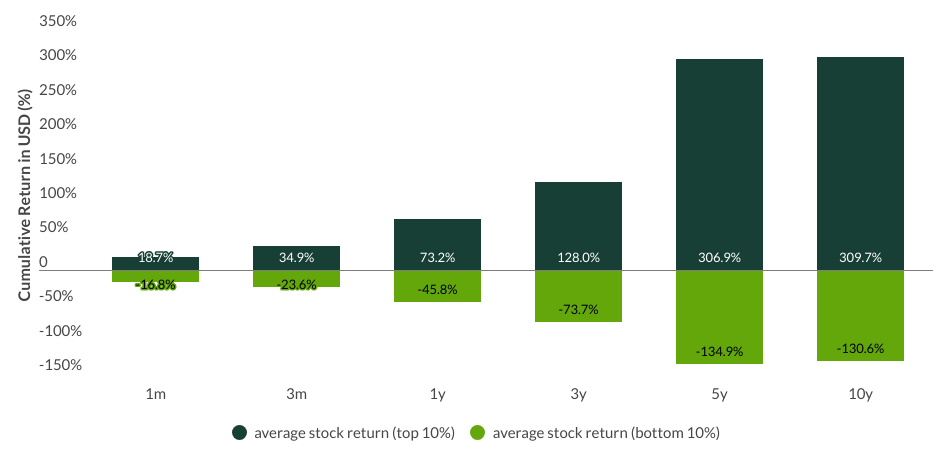
Source: MSCI Emerging Markets Index, as at 31 May 2025
In a world where markets rise consistently, that might seem like an acceptable outcome. But markets don’t move in straight lines; and in addition to the higher costs and transaction fees that come with frantic trading activity, the bigger issue is that investors miss out on what is far more important – the future value creation that the best companies tend to generate. This is often poorly understood by the market, with many investors simply focusing on the next quarter or year ahead. Yet the real drivers of returns lie in the cash flows that come well beyond that timeframe.
With that context in mind, we highlight the key contributors and detractors from performance over the fourth quarter of 2025.
The largest contributor to performance over the period was Samsung Electronics, a leading manufacturer of memory and semiconductor chips. In recent years, Samsung’s foundry business has been a major point of investor concern, which culminated in significant losses in the first half of 2025. These losses were exacerbated by one-time charges related to US export controls to China. The company has since undertaken a strategic shift from a “capacity-first” to a “customer-first” model, which appears to be bearing fruit. The shares rose during the quarter, as Samsung continued to benefit from surging AI-related demand for its high-bandwidth memory chips as well as tightness in traditional DRAM demand-supply. Strong results from US chipmaker Micron reinforced expectations of a sustained memory upcycle into 2026. With the turnaround in its foundry business and a strong legacy memory business, we believe the risk-reward looks favourable.
Taiwan Semiconductor Manufacturing (TSMC) was the second largest contributor to performance, as it continued to see solid revenue growth and strong demand from cloud AI for its leading-edge chips. Given the lead time and supply shortages, this provides visibility into 2026 earnings and possibly even beyond into 2027. TSMC is expected to invest in capacity expansion, with top line growth to follow.
The third largest contributor to performance was WEG, a Brazilian multinational electrical-equipment company. A leader in transformers and industrial electric motors, WEG continued to deliver solid profits in 2025, despite facing challenges due to US tariffs on imports from Brazil. Over the longer term, AI-driven power demand and the ongoing electrification of grids in Brazil and other key markets where WEG has a presence – including Mexico and South Africa – is expected to drive stronger revenue growth in the company’s core transformer business.
On the negative side, Tube Investments of India was the biggest detractor from performance, as it reported sluggish business performance and rising competition in the electric vehicle (EV) space. Despite its early mover advantage, Tube has struggled to maintain market share. It plans to arrest these challenges by increasing the number of dealership partners and entering new sub-segments in EV battery packs. On a positive note, the core business is stable with robust returns on capital employed, and it generates healthy free cash flow which is being invested in new businesses with high returns potential. In this endeavour, we are backing the management, particularly Vellayan Subbiah (executive chairman), who has an exceptional track record and has created tremendous value for shareholders.
Alibaba was the second biggest detractor. The shares weakened over the last few months of 2025 on concerns about its e-commerce business and the resulting pressure on earnings. Losses from its Taobao Instant Commerce business (food delivery and on-demand retail) weighed on the share price. On the other hand, Alibaba has had a strong run-up over 2025, driven by its investments into AI and growing demand for cloud computing. Alicloud revenue has accelerated in recent quarters and is expected to continue at pace in the coming quarters.
Milkyway Intelligent Supply Chain, a leading Chinese chemical materials logistics firm, was the third biggest detractor, declining due to underwhelming earnings results. The company’s revenue and profit growth lagged analyst expectations due to weak demand across China’s chemicals sector. While this weakness is likely to persist into 2026, the company is taking steps to improve the efficiency of its operations. Milkyway recently announced the launch of its new Fangchenggang hazardous chemicals base, which integrates warehousing with maritime, rail and road transport, and will allow Milkyway to offer customers improved supply chain services in southern China.
Looking forward
Despite the geopolitical uncertainty triggered by the US administration’s reciprocal tariff policy, emerging-market equities delivered robust performance in 2025. This reflects longer-term developments. The global economy is increasingly being led by emerging markets, a trend we expect to accelerate in the future. As concerns grow over the health of the US economy, investors are considering alternatives, as indicated by the strong demand for emerging-market equities over the last year.
Amid the market rise, it is important to keep a close eye on valuations. The growth in AI-related spending has led to a particularly sharp increase in the shares of chipmakers and other technology firms. While some of the Fund’s key holdings are benefiting from this trend, it is important not to get carried away by the hype around generative AI. In the tech sector as elsewhere, the Fund focuses on businesses with proven management teams and competitive advantages that allow them to capitalise on long-term shifts across emerging markets.
Whether it is the development of Chinese cities as hubs for innovation in medical devices, the formalisation of the Indian economy, the continued financialisation of the South African population, or the growing enterprise resource planning (ERP) adoption by Brazilian SMEs, there are plenty of investment opportunities in emerging markets. Yet these kinds of businesses are not widely included in major market benchmarks, which is why the Fund focuses on high-quality companies rather than following the crowd.
SFDR Article 9 and FSSA’s approach to sustainability
All SI portfolios will continue to be managed true to label, with due consideration given to SI’s SFDR Article 9 sustainability requirements. Importantly, both FSSA and SI had operated as one team for 27 years (1988-2015) before the decision was made in 2015 to split into two teams. This is heavily reflected in our investment philosophies and processes and our respective approaches to sustainability.
At FSSA, we believe it is everyone’s responsibility to think about sustainability as part of his or her investment decision-making. We don’t use external consultants or environmental, social and governance (ESG) ratings, nor do we outsource the sustainability work to a separate team. In our research, we focus on evaluating the long-term merits of a given investment opportunity. Given that sustainability issues are effectively investment issues, we believe that these challenges and opportunities – and management’s response to them – can have a significant impact on a company’s returns. As such, we look for evidence that the management operates the business effectively and in the interests of all stakeholders – both now and for the longer term.
While issues relating to climate change, or people and communities, are often the ones that get the most attention, most of our company engagements relate to management quality and corporate governance systems, as we believe that good governance is the foundation on which great companies are built. We often engage with management teams on capital allocation and strategy, remuneration structures and succession planning, board diversity and tenure, and ensuring high levels of transparency and company disclosure – to highlight just a few.
For more information on FSSA, or if you have any questions about the transition, please do not hesitate to contact us.
NB Both Stewart Investors and FSSA have been supported by the same centralised Responsible Investment team within the First Sentier Group, who will continue to support FSSA after the transition of SI funds.
Source for company information: First Sentier Group and company data. This stock information does not constitute any offer or inducement to enter into any investment activity. Portfolio data shown is from representative strategy accounts of the strategy shown above. Named new investments disclosed relate to holdings with a portfolio weight over 0.5%. It is not a recommendation or solicitation to purchase or invest in any fund. Differences between the representative account-specific constraints, currency or fees and those of a similarly managed fund or mandate would affect results.
Strategy update: Q3 2025
Global Emerging Markets Leaders strategy update: 1 July - 30 September 2025
Emerging markets enjoyed another strong quarter. Given that market indices were driven higher by sharp gains for Chinese stocks that are seen as beneficiaries of the artificial intelligence (AI) boom, it is unsurprising that returns from our strategy lagged some way behind those from the benchmark.
Although some of our Chinese holdings, such as Alibaba and Tencent, performed well, not all of our holdings there are aligned with the AI theme. Such periods of thematically driven exuberance can be challenging for long-term investors in high-quality businesses who are disciplined around valuations. But we know that our philosophy and process have been proven to deliver over the long term. One of our team, Doug Ledingham, recently wrote a piece explaining why we consciously resist the growing pressure to focus on the short term:
“At Stewart Investors, we have always sought to occupy a space that protects our clients’ capital. One of the threats we are striving to protect it from is short-termism: from the incessant distraction provided by 24-hour news, from the temptation to digest every morsel of noise, from the danger of trying to react to every macro data point or tweet, and from the pressure to fixate on quarterly earnings. That’s increasingly important in a world where long-term thinking is in increasingly short supply.”
You can read the rest of the piece here: Slow has all the power: why we invest alongside long-term owners. It helps to explain why we won’t be abandoning our core beliefs as long-term fundamental investors to chase the AI-driven rally in a bid to match returns from the index in the short term.
The long-term outlook for Indian companies remains bright
The quarter saw a continuation of an unhelpful dynamic: the significant outperformance of the Chinese market relative to India, to which this strategy has a significantly higher level of exposure. Despite this, we remain enthusiastic investors in high-quality companies aligned with India’s economic development. So far, this year has seen a reduction in income taxes and a simplification of the Goods and Service Tax (‘GST’) system. The Reserve Bank of India, meanwhile, has been cutting interest rates. So demand is now being supported by both fiscal and monetary loosening.
There is, of course, more to emerging markets than China and India. Recent trip reports from Indonesia, India and the Philippines are available on our Insights page. Having visited South Korea in September, we are increasingly confident in the changes to corporate governance standards that are unfolding in that country. These echo similar reforms seen in Japan and should have positive effects on shareholder returns in Korea and perhaps across the region more widely – a similar mood of reform now seems to be infecting other countries across Asia.
Continuity and change
It would be remiss not to mention the changes that have taken place at Stewart Investors over the last quarter. After acting as careful stewards of our clients’ capital over many years, three of our colleagues stepped back from their portfolio-management responsibilities in August and left the business. While the list of portfolio-management responsibilities within our team looks different now than it did when the quarter began, on a deeper level, nothing has changed: the philosophy and approach that has defined Stewart Investors since 1988 is deeply engrained and continues to define what we do. Our structure is flat. Every member of the investment team is first and foremost an analyst and our collective focus is on identifying high-quality companies, with resilient financials, guided by ambitious stewards.
Jack Nelson remains this strategy’s lead manager. He continues to apply the same principles to managing it that have guided it since its launch, working as part of the same tight-knit group of investment analysts and drawing on a common pool of investment ideas.
Activity
We added three new holdings to the portfolio over the quarter. There were no complete sales.
In addition to Shopee, the dominant e-commerce platform in Southeast Asia, Sea (Singapore: Consumer Discretionary) owns digital entertainment brand Garena and provides digital financial services through SeaMoney. Shopee is increasingly well established around the world, employing 45,000 ‘partner-drivers’ in Brazil.1 We believe Sea now has an opportunity to expand into new markets as well as increasing the penetration of Shopee and SeaMoney. The company’s founder, Forrest Li, remains closely involved in the business but is now supported by a professional management team. He has built a great franchise backed by solid financials (the company has net cash on its balance sheet) that empowers millions of small businesses to grow and create jobs by giving them direct access to their customers.
We also added a new holding in Motilal Oswal Financial Services (India: Financials), a brokerage and wealth management business that is poised to benefit from the desire of India’s increasingly wealthy middle class to have greater access to capital markets. It is still managed by its founders, including the eponymous Motilal Oswal and we can see a steady growth path ahead for the coming decades.
The final new position is MakeMyTrip (India: Consumer Discretionary), a leading online travel website. It should benefit from a continuing shift in India towards booking travel online. Meanwhile, as the disposable incomes of Indian consumers grow, they will increasingly want to travel overseas as well as domestically. While it is 49% owned by Trip.com, the Chinese online travel business, the company’s founders remain involved in the business’s day-to-day activities, supported by a professional management team. It is already a leader in the online travel space in India but the real growth opportunity lies in the offline segment, specifically in bus and hotel bookings, many of which continue to be made in bricks-and-mortar travel agencies.
[1] Source: Sea Shopee Celebrates 5 Years in Brazil, Strengthening Income Generation and Entrepreneurial Growth.
Source for company information: First Sentier Group and company data. This stock information does not constitute any offer or inducement to enter into any investment activity. Portfolio data shown is from representative strategy accounts of the strategy shown above. Named new investments disclosed relate to holdings with a portfolio weight over 0.5%. It is not a recommendation or solicitation to purchase or invest in any fund. Differences between the representative account-specific constraints, currency or fees and those of a similarly managed fund or mandate would affect results.

An affiliate of First Sentier Group
Copyright © 2026 Stewart Investors.